
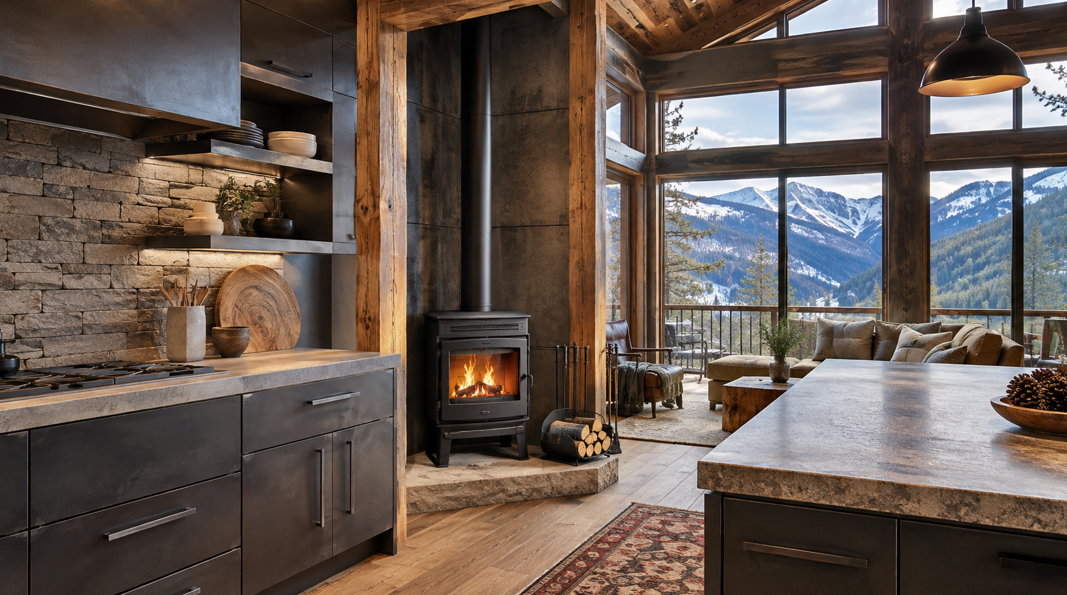
A Safer Starting Point for a Warm Mountain Home
A wood stove can be one of the most welcoming features in a Western Montana home. It brings steady warmth, creates a natural gathering place, and fits beautifully with rustic cabins, mountain-modern interiors, and practical family spaces. Once cabinetry enters the plan, though, appearance is only part of the decision.
Most residential cabinets contain combustible materials. Solid wood, plywood, medium-density fibreboard, particleboard, veneers, finishes, adhesives, trim, and decorative panels can all react to sustained heat or flame. That does not mean cabinets cannot be used in a room with a wood stove. It means the layout needs to begin with the stove manufacturer’s installation instructions and required clearances, not with a cabinet style or finish.
Missoula Floors helps homeowners across Western Montana coordinate cabinetry, flooring, countertops, and other interior finishes for spaces that feel beautiful and practical. In a wood-stove room, that coordinated approach can help the stove remain a focal point without crowding it with built-ins or storage.
So, what are “fire-resistant cabinets”? In everyday design conversations, the phrase usually refers to cabinetry made from materials that resist ignition, limit flame spread, or do not contribute fuel in the same way as standard wood products. It does not mean a cabinet is fireproof, and it does not allow cabinetry to be placed inside a stove’s required clearance area.
The safest approach is straightforward: identify the stove model, review its listed clearances, protect combustible floors and nearby surfaces as required, and have the installation reviewed by a qualified professional. The U.S. Environmental Protection Agency also recommends proper clearances, floor protection, correct venting assembly, and professional installation.
What “Fire-Resistant” Means in Cabinet Planning
The language used around fire performance can be confusing. A product may be described as noncombustible, fire-resistant, fire-retardant-treated, heat-resistant, or flame-spread-rated. These terms are not interchangeable.
Noncombustible Materials
A noncombustible material does not provide fuel for a fire in the way wood-based products do. Steel is the most realistic example for residential cabinetry. It can be a strong option for utility areas, mudrooms, workshops, modern kitchens, and mountain homes that use black or brushed metal accents.
However, noncombustible does not mean unaffected by heat. Metal conducts heat, and a metal cabinet can transfer that heat to its contents, hardware, liners, wall connections, or surrounding materials. It still needs to remain outside the required clearance area unless the entire installation has been specifically approved for another configuration.
Fire-Retardant-Treated Materials
Fire-retardant-treated wood products are designed or treated to achieve documented fire-performance characteristics under defined test conditions. They may slow ignition or reduce flame spread compared with untreated wood products.
The important word is “documented.” Do not assume a product is fire-retardant because it is engineered, commercial-grade, thick, or coated. Review its rating, intended indoor use, finish compatibility, installation requirements, and warranty.
A treated panel also does not make the complete cabinet fire-resistant. Doors, backs, fillers, shelves, adhesives, and finishes may use different materials.
Combustible Cabinet Materials
Solid wood, plywood, MDF, particleboard, many laminates, veneers, and most decorative trims are combustible. They can still be excellent cabinet materials when used in the right location. Their strength, beauty, and long-term value are not the issue. The issue is whether they are positioned outside the stove and venting system’s required clearances.
Current residential code guidance states that appliance clearances from unprotected combustible materials are based on the appliance label and the manufacturer’s installation instructions. That is why no single measurement works for every stove or every home.
Cabinet Materials Worth Considering Near Wood-Stove Areas
There is no universal “best” cabinet material for every mountain home. The right choice depends on the room, stove location, required clearances, storage needs, design style, and product documentation.
Steel Cabinetry
Steel cabinetry is the clearest noncombustible option for homeowners who want built-in or freestanding storage in the general area of a wood stove.
Advantages:
Steel does not contribute fuel in the same way as wood-based cabinetry.
Powder-coated finishes can provide a clean, durable surface.
Matte black, charcoal, bronze, and warm metallic finishes suit mountain-modern interiors.
Stainless steel can be practical in kitchens, utility rooms, and mudrooms where easy cleaning matters.
Metal cabinets can coordinate well with stove doors, venting, hardware, and fireplace tools.
Limitations:
Steel conducts heat and can become hot.
Some metal cabinets contain combustible liners, shelves, gaskets, coatings, or backing materials.
Custom sizing and residential finishes may increase the project cost.
A fully metal cabinet may feel too industrial for a traditional or rustic room.
Noncombustible construction does not cancel the stove’s clearance requirements.
Steel cabinetry best suits homeowners who like a clean, functional look and will verify the complete construction, not only the visible door.
Stainless-Steel Cabinetry
Stainless steel offers similar fire-conscious benefits, plus resistance to moisture, staining, and routine wear. It can work well in a mudroom, utility zone, or hardworking kitchen. Natural stone, warm flooring, and brushed hardware can soften its more commercial appearance.
Documented Fire-Retardant-Treated Wood Products
Homeowners who prefer wood’s warmth may discuss a documented fire-retardant-treated product with the design and installation team, particularly when a project specification calls for enhanced fire performance.
Before selecting it, ask:
Is the product rated for interior use?
Does the documentation apply to the exact panel or complete cabinet?
Can the material be painted, stained, or veneered without affecting its rating?
Are specific adhesives, fasteners, or edge treatments required?
Does the manufacturer identify humidity or moisture limitations?
Is the product approved for the proposed application?
This option best suits projects with clear specifications and professional oversight. It does not replace required spacing.
Hybrid Cabinet Designs
For many homes, a hybrid layout is the most practical solution. Standard wood cabinetry remains outside the clearance zone while approved noncombustible materials or tested assemblies are used where required.
A hybrid plan might include:
A clear open area between the stove and the main cabinet run
Lower cabinetry positioned farther from rising heat
Metal accents that visually connect the cabinets and stove
Freestanding storage in a safer part of the room
Stone or tile used as a coordinated finish within an approved assembly
Tall pantry or media cabinets placed away from the stove and vent connector
Homeowners can explore professionally selected cabinets that coordinate with the room’s flooring, countertops, hardware, and mountain-home style. The layout can then be developed around the stove’s actual requirements rather than trying to make a preferred cabinet configuration fit too close to the appliance.
Common Cabinet Materials That Need Extra Planning
Familiar cabinet materials can perform beautifully in a room with a wood stove when they are positioned responsibly. Their everyday durability should not be confused with fire resistance.
Solid Wood
Solid wood brings warmth, character, and natural variation to mountain interiors. Oak, maple, hickory, alder, and other species can complement stone, wide-plank flooring, and black metal details.
Wood remains combustible regardless of its density, thickness, or species. Long-term heat exposure may also affect colour, finish, joints, and moisture movement. A dense hardwood is not automatically a safer choice beside a stove than a softer species.
Plywood Cabinet Boxes
Quality plywood is valued for strength, screw-holding ability, and dimensional stability. It is commonly used in durable residential cabinetry, but standard plywood is still wood-based and combustible.
Plywood can be a dependable choice outside the required clearance area. The design team should also consider exposed cabinet sides, backs, fillers, toe kicks, and decorative end panels, since each may sit closer to the stove than the main door front.
MDF and Particleboard
MDF creates smooth painted doors and consistent panels, while particleboard can provide stable cabinet components at a strong value. Both contain wood fibres or particles combined with binding materials.
These products are not inherently unsuitable for a wood-stove room. They simply need the same responsible clearance planning as other combustible cabinet materials. Heat can also affect coatings, edge banding, and adhesives before obvious damage appears on the visible surface.
Laminate, Thermofoil, and Veneer
A decorative surface does not reveal the complete cabinet’s fire behaviour. Laminate, thermofoil, and veneer are often applied over combustible cores, while adhesives and surface layers can react differently to heat. Ask for full construction details rather than judging by appearance.
Paints, Stains, and Clear Coatings
Cabinet finishes are generally selected for appearance, cleanability, and wear resistance. A durable paint or clear coat is not automatically a fire-retardant coating.
When enhanced fire performance is part of the project, request written product information. Avoid relying on informal claims such as “heatproof” or “commercial strength” without a recognised test standard or intended-use statement.
Why Layout Matters More Than a Material Label
Responsible cabinet planning starts with the exact stove and venting configuration. Before measurements are finalised, locate the appliance label and installation manual. Clearances can differ by model, wall construction, connector type, and approved protective system.
Measure More Than the Cabinet Box
A cabinet may appear comfortably spaced when closed but create a problem when used. Review the full operating space, including:
Doors at their widest opening
Fully extended drawers
Pulls, knobs, and handles
Countertop overhangs
Open shelves
Crown moulding and decorative trim
Side panels and fillers
Nearby seating or walkways
Baskets, curtains, and movable décor
Firewood, kindling, paper, and cleaning supplies
The vent connector also needs attention. A cabinet may be far enough from the stove body but too close to a pipe or another heat-producing component.
Do Not Treat Decorative Surfaces as Heat Shields
Tile, stone, sheet metal, and cement board are often described casually as heat shields. On their own, they may simply be decorative surfaces.
Approved clearance-reduction systems depend on more than the face material. They may require a listed assembly, specific air gaps, noncombustible spacers, open edges for ventilation, minimum dimensions, and particular installation methods. The 2024 International Residential Code describes labelled assemblies and detailed requirements for certain clearance-reduction systems, including provisions for ventilated airspace.
This is not a good place for an improvised solution. A qualified stove professional or local building authority can confirm whether a proposed protective assembly is recognised for the appliance and jurisdiction.
Leave Room for Use and Maintenance
A well-designed room leaves space to load the stove, remove ash, clean surfaces, inspect components, and move comfortably. Cabinet doors should not block access or create a narrow path. Moving storage to another wall or leaving an open transition zone can improve safety and visual balance.
Designing for Western Montana Homes
Across Missoula, Hamilton, Polson, Superior, and Stevensville, mountain-home design often blends hardworking materials with natural textures and comfortable finishes.
Plan for Dry Winter Conditions
Long heating seasons can create dry indoor conditions. Natural wood doors and panels may expand or contract as humidity changes, and painted joints can become more noticeable over time.
Ask the cabinet manufacturer about recommended indoor conditions, finish care, and seasonal adjustment. There is no single humidity target that applies to every cabinet line, so product-specific guidance is more useful than a general rule.
Match the Cabinet to the Room
A kitchen may prioritise easy-clean finishes and organised storage. A mudroom may need durable doors for snow, boots, pet gear, and firewood debris. A living room may call for furniture-style cabinetry that keeps books and electronics away from the stove.
Cabins and smaller homes often benefit from vertical storage, but tall cabinets need thoughtful placement because heat rises. Moving a tall cabinet to the opposite wall may create a more balanced room while protecting the cabinet finish and contents from prolonged warmth.
Keep the Mountain Look Cohesive
Fire-conscious planning does not require a stark or commercial-looking room. Consider combinations such as:
Warm wood cabinets with matte black metal accents
Earth-tone painted cabinetry with stone-inspired surfaces
Simple slab doors for a mountain-modern look
Shaker doors for a transitional or rustic interior
Brushed nickel or bronze hardware
Natural flooring that visually connects the room
Open space around the stove framed by coordinated finishes
Colour, thickness, and rustic appearance do not change a material’s fire performance. Keep aesthetic choices separate from tested safety characteristics.
A Practical Planning Checklist
Bring the following questions and information to the early planning stage. It is easier to adjust a layout before cabinets are ordered than after installation begins.
Questions About the Stove
What is the exact make and model?
Is the current installation manual available?
What clearances are listed for the stove body and vent connector?
Has the stove, pipe, chimney, or wall protection changed since installation?
Is the appliance professionally installed and maintained?
Does the proposed cabinet location affect cleaning, loading, or inspection access?
The EPA recommends professional installation and maintenance because correct placement, venting, floor protection, and component assembly all affect safe performance.
Questions About the Cabinets
Is each cabinet component combustible, noncombustible, or fire-retardant-treated?
Does the manufacturer provide documented fire-performance information?
What materials are used in the doors, box, backing, fillers, shelves, and trim?
Are the finish and adhesives suitable for the intended location?
Could an open door or drawer enter the required clearance area?
Will the cabinet store paper, kindling, cleaners, electronics, or other heat-sensitive items?
How will the cabinet respond to dry winter conditions?
Information to Bring to a Design Consultation
Room dimensions
Clear photos of the stove and surrounding walls
The stove’s make, model, and manual
Locations of the chimney and vent connector
Notes from the stove installer or building authority
Photos of preferred cabinet styles
Samples or photos of the flooring and countertops
A list of items that need storage
Measurements of doors, windows, walkways, and nearby furniture
Create a Warm, Well-Planned Interior
The best cabinet choice for a mountain home with a wood stove is not defined by one material label. Steel and stainless steel can provide noncombustible cabinet construction, documented fire-retardant-treated products may fit certain professionally reviewed projects, and standard wood-based cabinetry can work beautifully when it remains outside all required clearances.
The bigger decision is how the room works as a whole. The stove, venting, protective assemblies, cabinets, door swings, storage, circulation, and maintenance access need one coordinated plan. A decorative panel or metal cabinet cannot make an unsuitable placement acceptable.
Missoula Floors brings product knowledge, personalised design support, quality materials, free in-home estimates, and local experience to projects across Western Montana. The team can help homeowners develop a cabinet plan that feels warm, practical, and connected to the rest of the interior while the stove installation requirements are confirmed by the appropriate professionals.
Planning cabinetry for a room with a wood stove? Get in touch with the Missoula Floors team to discuss a beautiful, practical layout for your Western Montana home.